
Dry Land Development Programme
What is the DLDP?
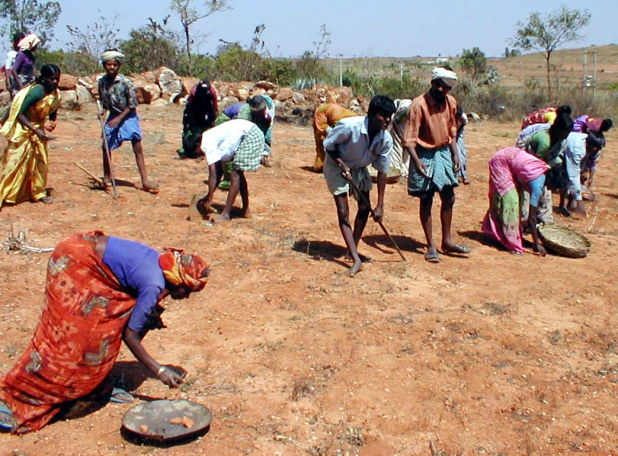
For 22 years, from 1986 to 2008, ADATS implemented a DLDP on 60,148 acres of lands owned by Coolie Sangha members. Labour capital was made available for each village CSU to collectively work on their scattered patches of dry land, averaging 3.5 acres per family, for 100 days every year in the 4 summer months. They themselves divided person-day allotments according to land holding and the condition of each patch of land. The entire CSU then descended on each holding from March to June every year.
They split themselves into work gangs and descended on each other's holdings to do labour intensive works. One person from each Member family went to work. Each land owner decided on the actual Soil & Water Conservation (S&WC) work needed on her land. ADATS Staff gave technical advice and monitored the actual works. DLDP wages were paid to the actual persons who worked on these lands. Land owners did not receive any direct monetary benefit.
In the beginning, we paid a "wage" of ₹ 3 per day and gradually increased to ₹ 15 per day as and when ADATS was able to mobilise more resources.
Soil & Water Conservation Works
For the first 3-4 years, lands were cleared of pebbles and boulders. After that, S&WC works like stone contour bunding, ravine and gully check, diversion channels, etc. were taken up. Trees were planted on the bunds, and shrubs and grasses allowed to grow on them.
S&WC works were once again taken up on the same plots, after a gap of 2-3 years, in order to tackle the new contours of erosion had, in the meantime, chequered the terrain.
In this manner, with a labour investment of 8-11 years, Coolie lands were cleared, levelled and bunded, rain water retained for a moment, moisture in the soil increased, and soil erosion reduced. This made the lands cultivable. Yields and holding sizes increased.
DLDP vs Watershed Programmes
The DLDP was a not a watershed programme treating just the fractures in a contiguous landscape, turning a blind eye to socioeconomic aspects of fissures in landholding patterns. Please see 12 documents beginning with ICCO's 1st Letter on the DLDP.
Actual Works Done
The DLDP was a pluralistic effort comprising a whole range of indigenously conceived S&WC measures. Each individual land owner decided on the type of labour input needed on each separate field. One could not visit just a couple of villages and claim to have seen it all. The variance and variety never failed to invite awe and surprise. They were invariably huger than what we normally visualise human labour as capable of. The collective output of the labour of 20-25 determined persons in a work gang was never a simple arithmetic of their individual muscle power. They literally moved mountains, magically converting marginal lands into productive fields.
Under such circumstances it is difficult to describe DLDP works even under the 13 broad categories that we give below.
| New Stone Contour Bunds | 1,010,515 | Metres |
| Strengthen Existing Bunds | 120,174 | Metres |
| Ravine & Gully Check | 2,402 | |
| Clear Shrubs & Boulders | 10,775 | Acres |
| Field Bunds | 180,764 | Metres |
| Retention Walls (Kanji) | 129,774 | Metres |
| Diversion Channels | 62,297 | Metres |
| Cattle Walls | 23,635 | Metres |
| Deepen Open Wells | 120 | |
| Farm Ponds | 75 | |
| Pit for trees | 88 | Acres |
| Paths & Roads | 2,197 | Metres |
| Wasted Works | 37 | Acres |
The DLDP also included Silt Hauling onto Coolie lands from the beds of irrigation tanks, Compost Making, Seed Treatment, Planting Trees, promoting Kitchen Gardens, training women masons to build Smokeless Chullas (fuel efficient wood stoves), assisting sweeper women to set up Vermicompost Units to make manure from earthworms, and a host of other activities.
Investments
Over 22 years ₹ 7,75,45,485 worth of Soil & Water Conservation Works were been carried out on a total of 60,148 acres acres of Coolie owned lands. But not every village implemented DLDP works on every single landholding every single year.
| Work Done | |||
|---|---|---|---|
| 13,659 acres | 23% | 1 Year Work Done | ₹ 61,46,582 |
| 16,360 acres | 27% | 2 Years Work Done | ₹ 1,47,23,960 |
| 12,746 acres | 21% | 3 Years Work Done | ₹ 1,72,07,451 |
| 7,683 acres | 13% | 4 Years Work Done | ₹ 1,38,29,706 |
| 4,790 acres | 8% | 5 Years Work Done | ₹ 1,07,77,208 |
| 2,651 acres | 4% | 6 Years Work Done | ₹ 71,57,754 |
| 1,355 acres | 2% | 7 Years Work Done | ₹ 42,68,313 |
| 598 acres | 1% | 8 Years Work Done | ₹ 21 |
| 216 acres | - | 9 Years Work Done | ₹ 8,73,990 |
| 80 acres | - | 10 Years Work Done | ₹ 3,61,935 |
| 9 acres | - | 11 Years Work Done | ₹ 46,184 |
| 60,148 acres | 100% | ₹ 7,75,45,485 |
16,935 acres (i.e. 49% of Coolie owned lands) were completely cleared of shrubs and boulders, contour bunded and levelled, and another 4,316 acres (13%) need just 1 more year of labour investment. Thereby, 62% of Coolie holdings became on par with those owned by middle peasant farmers in terms of yield as well as value.
Precursor to MG-NREGA
In 2008 we estimated that another ₹ 2,26,48,135 worth of S&WC works needed to be invested on 34,407 acres of Coolie owned lands over the next 5 years. When the Employment Guarantee Act was passed as a fundamental right to work, we stopped the DLDP and concentrated on implementing a leakage free NREGA works in the villages.
Member Coolie families took great pride that their effort, studied by the central leadership, was one of the precursors to the MG-NREGA.
Postscript
ADATS undertook a massive education campaign to explain the Act and procedural details. For the next two years, impressive leakage-free NREGA works were planned and executed on the exact same lines as the just stopped DLDP, albeit with a hugely increased daily wage of over ₹ 75.
Being a universal entitlement, non Coolie Sangha families also formed work gangs, but without the across-the-caste-lines unity and discipline that bonded CSU Members. They had neither the physical strength nor the inclination to labour in the burning sun.
Entrepreneurial youth from respective caste groups conspired with young Panchayat Development Officers, especially appointed to oversee NREGA implementation. They "bought" job cards, collected bank account details, manipulated records and drew NREGA wages. In return, their "clients" received a share for not doing any work. The nexus was complete.
A brand-new class of ethnic contractors emerged. They brought JCBs, bulldozers and earthmoving machinery which marked the end of capitalising manual labour to create village infrastructure. Even the digging of 1 metre cube pits for planting saplings on their own fields is now done with JCBs.
Still later it was the turn of state/central schemes to appropriate NREGA resources for purposes they considered important. Some were worthwhile causes, some not. Very soon, genuine NREGA works carried out by work gangs themselves choosing tasks disappeared, except on official records. Honest participants were able to get less than 30% of their 100 days entitlement. Wage payments for this stubborn minority was abnormally delayed. After a while, Coolie Sangha families gave up and resigned themselves to the new normal.
MG-NREGA is no longer a resource at their command to invest in works of their choosing through community controlled, bottom-up planned and jointly executed efforts.